EULEP Project Evaluation Meeting
27.11.2025 / Ankara
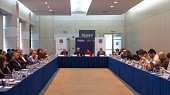
The EULEP Project Evaluation Meeting was held at the Turkish Economic Policies Research Foundation (TEPAV) with the participation of relevant institutions and organizations.
The meeting, jointly organized by TOBB, TEPAV, and TOBB ETÜ, featured opening remarks by TEPAV Founding Director Prof. Dr. Güven Sak and TOBB Real Sector R&D and Application Department Head M. Kemal Günay.
In his speech, M. Kemal Günay said that the EULEP Project was carried out under the leadership of the European Union of Chambers of Commerce and Industry (EUROCHAMBRES).
Günay stated that the project aims to identify companies’ needs in the areas of artificial intelligence, virtual reality, and social innovation, and to develop innovative vocational training methods accordingly. He also noted that the project is being carried out in our country under the leadership of TOBB.
Following the opening speeches, presentations introducing the project were made, and the project outputs were presented to relevant public institutions to exchange views on its sustainability.
Presentations were made about the “European Learning Experience Platform – EULEP” project, a Vocational Excellence Project funded by the EU. It was explained that an international study had been conducted for 3.5 years with 8 countries and 20 institutions, and that course content had been prepared together in the fields of Artificial Intelligence, Virtual Reality, and Social Innovation for the business world.
The project was cited as a best practice by the European Commission during the EU Industry Days, both for effectively establishing skill ecosystems and knowledge triangles in line with the CoVE (Centers of Vocational Excellence) objective, and for adopting a bottom-up approach by consulting businesses through surveys at every stage.
It was stated that the training content was tested by 180 trainers in 8 countries and 32 university lecturers from our country. It was explained that 537 company employees from our country alone registered for the pilot trial application of the Artificial Intelligence, Virtual Reality, and Social Innovation Courses, and 192 of them were eligible to receive certificates.
At the meeting where opinions and suggestions were discussed to ensure the long-term use of project outputs, concrete suggestions were received from representatives of public institutions (Ministry of National Education, YÖK, İŞKUR, etc.), OSB, universities, etc. regarding the official validation, recognition, and certification of existing courses and where and how they could be utilized in both formal and informal education in our country; an important step was taken for the action plan to be prepared in the continuation of the project.
Your message has been sent
Thank you |
|