Software Council Meeting determins software sector’s 2026 roadmap
15.01.2026 /
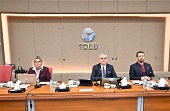
The TOBB Türkiye Software Council held its first Council meeting of 2026, chaired by Council President Ertan Barut and attended by Council Members and Committee Chairs, with TOBB Board Member Mehmet Büyüksimitci participating online.
In his opening speech, TOBB Board Member Mehmet Büyüksimitci emphasized the importance of a “collective intelligence” approach in realizing the sector’s potential, stating that the sectoral outputs of the 14 technology-focused subcommittees established within the Council would take the sector to a higher level.
Council President Ertan Barut emphasized the goal of positioning Türkiye as a reputable, reliable, and scalable software country on a global scale.
In his assessment for 2025, Barut shared that the sector’s export target is approaching $6 billion. He also noted that TOBB’s initiatives were effective in extending the decision to implement 100% remote work support in TGBs for another year, as well as in the cooperation processes to be carried out with public institutions. Regarding regulatory developments, he conveyed that the processes had been completed with the updates to the Public Information Technology Services Procurement Regulation and the publication of the Domestic Goods Communiqué and TÜR Certificate Regulation.
The main agenda of the meeting was the work of the 14 newly established technology-focused committees. With the participation of representatives from different provinces of Anatolia, the committees, which have become more inclusive, completed their work for this period and, under the moderation of Deputy Council Chairman Salih Kükrek, each committee chair and their deputies presented three key problems and three proposed solutions.
The meeting also included the sharing of 2026 targets and a new action plan. In this context, information was provided about the AI Road Show event, planned to be held in seven provinces by the end of June, which aims to inform SMEs and industrialists about artificial intelligence.
Barut noted that the Türkiye Software Council, which forms the backbone of Türkiye’s software ecosystem and keeps it alive, has a very important goal of making Türkiye a reputable, reliable, and scalable software country on a global scale. He said, “As a sector, we must all embrace this goal together; to do this, we first need to expand our strategic infrastructure and capacity.” He emphasized the need to participate in the Ministry of Industry and Technology’s HİT-30 and RİP calls by forming strong consortiums to develop national products and projects. Noting that artificial intelligence and cybersecurity have brought data centers into a more strategic position, Barut expressed the need to increase investments in this area.
Barut pointed to a new wave of transformation in technology, stating that not only the integration of artificial intelligence but also the rise of agent-based systems that plan and execute on their own will be decisive. Barut emphasized that in software, it is no longer just speed but also trust, compliance, controllability, and sustainability that have become criteria for market entry. He drew attention to the importance of strategic measures to ensure that AI-driven investments do not increase the risk of external dependency and do not strain macroeconomic balances.
In the evaluation section of the meeting, Council members took the floor and expressed their satisfaction with the committees’ work. Members stressed that the issues raised by the committees should be gathered under a common “sector problem pool” and addressed with a holistic approach, particularly in the areas of human resources, education, and financing.
To meet the need for qualified labor, it was recommended to strengthen university-NGO-private sector partnerships, establish long-term internship and academy models, and develop mentoring mechanisms for technology parks/TEKMER companies. It was also stated that permanent mechanisms should be developed to facilitate access to financing and scaling for startups, and that standardization, integration, and common language should be prioritized to increase the strategic impact of domestic software. Clarifying expectations in public-private partnerships, ensuring consistency in public procurement, and conducting inventory/analysis studies on the use of imported software were also among the important topics on the agenda.
The meeting also noted that efforts would be planned to hold an informational seminar on the Cyber Resilience Act (CRA) for SMEs, industrialists, and the IT/software sector, as well as a sector-specific informational webinar within the scope of Ministry of Finance regulations.
At the end of the meeting, it was decided to prepare a “2026 Action Plan” with the problems and solution proposals from the committees and share it with the public and the sector, as well as to hold information seminars and webinars focused on regulatory compliance.
Your message has been sent
Thank you |
|