TOBB Higher Education Council consultation meeting held at YÖK
16.02.2026 / Ankara
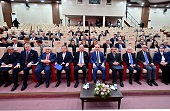
The Union of Chambers and Commodity Exchanges of Türkiye (TOBB) Higher Education Council consultation meeting was held at the Higher Education Council (YÖK). The meeting, which began with opening speeches by TOBB Board Member Seyit Ardıç, YÖK President Erol Özvar, and Council President Bekir Okan, addressed topics such as university-industry cooperation, quality in higher education, education policies, and training human resources to meet sectoral needs.
TOBB Board Member Seyit Ardıç emphasized the importance of sharing the expectations of the private sector more strongly with universities.
Ardıç emphasized that vocational schools aim to adapt to sectoral needs, stating, “A strong economy, sustainable development, and a competitive country structure are not possible without qualified human resources. Nurturing this resource and benefiting from it is only possible with universities that have a global vision that evolves with technological developments.We are in a period where learning experiences are changing, the use of artificial intelligence is evolving towards industry, and is becoming increasingly deep. Our goal is to ensure that our graduates enter the workforce not only with a diploma, but also equipped with knowledge and skills in the field. Under this protocol, we aim to make our vocational colleges more responsive to the real needs of the sector and more aligned with the expectations of the business world,” he said.
YÖK President Erol Özvar stated that they are working together with foundation universities, adding, “Our goal here is to take the existing accumulation further while addressing the problems encountered with a constructive approach and contributing to the further strengthening of the institutional capacities of our foundation higher education institutions. The higher education system is not only a structure that meets today’s needs, but also a strategic area that directly affects our country’s medium and long-term development goals, human capital strategy, and global competitiveness. For this reason, every decision regarding university quotas is approached with a multidimensional and forward-looking perspective, rather than a short-term approach. We work in regular contact with all relevant public institutions, particularly ministries. We examine the medium and long-term service delivery capacities of these institutions in detail,” he said.
Özvar stated that they have reduced quotas in some programs to increase employment opportunities for graduates, adding, “All these views and suggestions ensure that our quota decisions are based on field and social realities. We continuously analyze which areas have an increased need for human resources, which professions have reached saturation, and which areas will gain strategic importance in the future. These comprehensive assessments form the basis of our quota policies. The first of these is the complete closure of second-shift programs. This decision is a concrete reflection of an approach that prioritizes quality over quantity in higher education. Similarly, we have gradually reduced quotas in some programs that are increasingly limiting the employment opportunities of graduates.”
Your message has been sent
Thank you |
|